Fetal Alcohol Syndrome Face: Features, Diagnosis, and What They Mean
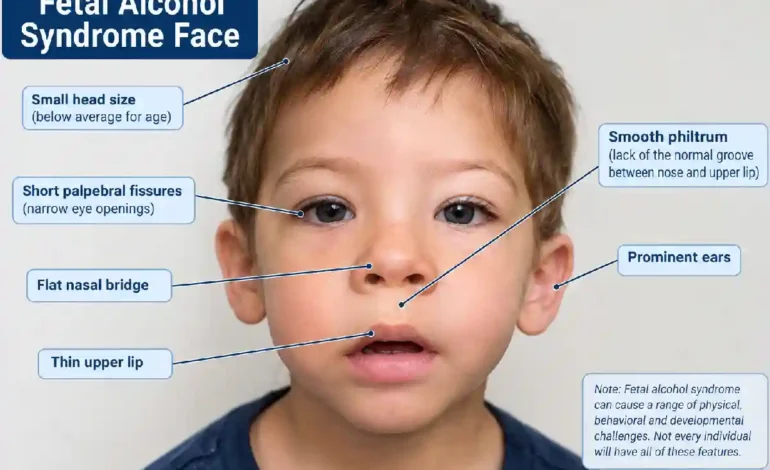
Fetal alcohol syndrome face is an assortment of distinct facial features that may be found in persons with fetal alcohol syndrome. Fetal alcohol syndrome is one of the many disorders associated with fetal alcohol spectrum disorders.
It is essential to know that the aforementioned facial features can be an important factor in the diagnosis of fetal alcohol syndrome; however, one should never use only the facial features for making a diagnosis of FASD. A thorough evaluation must consider the presence of facial features together with growth problems, neurological abnormalities, personal medical history, and possible exposure to alcohol in the uterus. The American Academy of Pediatrics notes that individual features are not specific to the mentioned disorders and can be associated with others as well.
Understanding the meaning of the mentioned signs will help individuals and parents receive the necessary medical assessment.
What Is Fetal Alcohol Syndrome?
Fetal alcohol syndrome is a syndrome caused by alcohol consumption before the birth of a baby. This condition is included in many fetal alcohol spectrum disorders and leads to the appearance of physical, developmental, behavioral, and learning issues in children.
According to the Centers for Disease Control and Prevention, FASD involves defects of the central nervous system, growth deficiency, and unique facial characteristics. Some other effects of the disease are learning disabilities, memory and attention impairment, communication problems, and vision and hearing problems.
FASD is a spectrum; therefore, the symptoms of such patients can widely differ in occurrence and severity.
Patients with a history of alcohol consumption before their birth can suffer from neurodevelopmental problems even without the unique facial patterning of FAS.
What is a Face with Fetal Alcohol Syndrome?
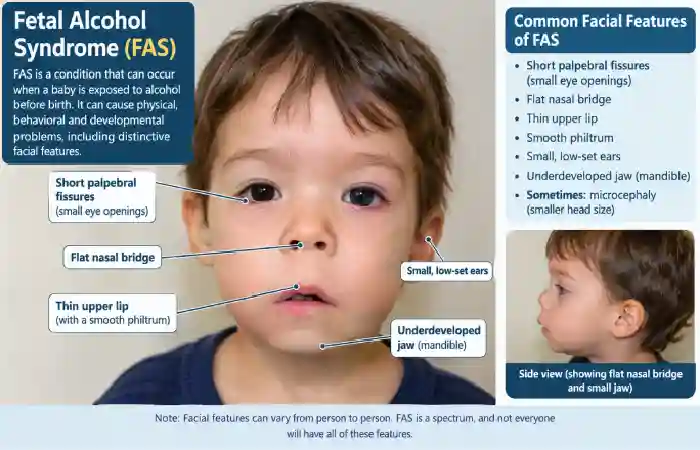
Three main facial characteristics create the unique facial patterning of fetal alcohol syndrome:
- Shorter palpebral fissure length
- Smooth philtrum
- Thin upper lip / upper vermilion border
These characteristics are called the cardinal facial characteristics of FAS.
- Shorter Palpebral Fissures
The palpebral fissure is the space between the upper and the lower eyelids.
- Smooth Philtrum
Philtrum is defined as the vertical groove that exists between the lower end of the nose and upper lip.
A normal person’s philtrum will have ridges or be grooved. In the case of facial features of FAS, there may be a smooth or indistinct philtrum.
A single characteristic like a smooth philtrum cannot make a diagnosis of Fetal Alcohol Syndrome.
- Thin Upper Lip
The third feature comprises a thin vermilion of the upper lip, which indicates the existence of a thin, colored upper lip.
During clinical examination, a standardized process is adopted to check the upper lip, instead of only seeing if someone has thin lips by looking at a picture.
Facial Features Linked to Prenatal Alcohol Consumption
Other than the three facial features, there are some other physical features of prenatal alcohol consumption that a patient may develop.
Physical features seen in a patient include:
- Midface hypoplasia
- An abnormally small jaw
- Ear deformities
- Nasal deformities in terms of position and shape
- Small head size
- Others
It should be noted that these features alone cannot diagnose FAS. As per the American Academy of Pediatrics, physical features related to prenatal alcohol consumption also have similarities with other syndromes and disorders.
Can You Diagnose Fetal Alcohol Syndrome From a Face?
No.
A person cannot have a diagnosis of fetal alcohol syndrome based only on the appearance of their face.
Facial features are significant for diagnosis; however, FAS diagnosis goes beyond facial appearance. Depending on the diagnostic criteria, clinicians also assess growth, CNS development or functioning, prenatal alcohol exposure, and other conditions causing these findings.
According to the American Academy of Pediatrics, individual facial dysmorphisms are not characteristic of only one syndrome. Other genetic syndromes and diseases may cause similar facial features.
It is important to note that pictures on the Internet, facial recognition software, or a comparison of a person’s face with someone else’s face cannot serve as a diagnosis.
Do People With FASD All Have a Fetal Alcohol Syndrome Face?
Not always.
FASD includes a wide range of diagnoses, and not all people affected by prenatal alcohol exposure have typical features of FAS.
According to the AAP, the neurodevelopmental disorders associated with prenatal alcohol exposure occur either with or without characteristic facial findings.
It is important because the absence of the characteristic pattern of facial dysmorphisms does not automatically imply the lack of impact of prenatal alcohol exposure.
A person may have issues with:
- Learning
- Memory
- Attention
- Executive functioning
- Self-regulation
- Communication
- Adaptive skills
- Behavior
- Growth
without having the complete facial phenotype associated with FAS.
How Is Fetal Alcohol Syndrome Diagnosed?
Diagnosis entails the conduct of a clinical assessment rather than just an observation test.
There are a number of factors that healthcare practitioners can choose to assess.
Medical and Developmental History
Practitioners may choose to inquire about:
- Pregnancy history
- Prenatal alcohol exposure
- Growth history
- Developmental milestones
- Learning problems
- Behavioral problems
- Medical problems
- Family medical history
It can assist clinicians in determining the need for additional assessment for FASD.
Physical Examination
A practitioner may choose to check for growth parameters, head circumference, facial appearance, and any other physical parameters.
In cases where the facial parameters are characteristic of FASD, then the standardized assessment techniques can be conducted rather than subjective observations.
Neurodevelopmental Assessment
It is important to note that FASD can affect the functioning of the brain and nervous system.
Depending on age and symptoms, an assessment can involve:
- Cognition
- Memory
- Attention
- Learning
- Executive functions
- Language
- Adaptive functioning
- Self-regulation
Differential Diagnosis
Clinicians may also want to consider other factors for the causes of growth problems, developmental concerns, and any other abnormal facial features.
According to the AAP, there are other genetic syndromes that can show similar facial features as FASD.
What Causes the Fetal Alcohol Syndrome Face?
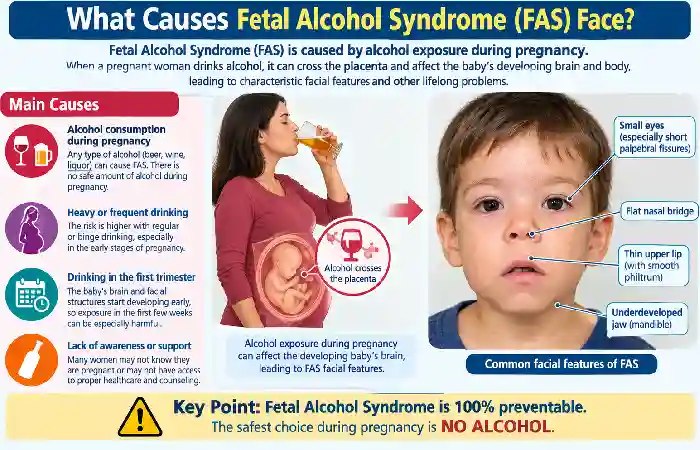
Features associate with FAS are cause by the effect of alcohol on the developing fetus.
The fetus absorbs alcohol through the placenta.
According to the CDC, FASDs are related to the effect of fetal exposure to alcohol before birth.
The effects of fetal exposure to alcohol affect different fetal developments, such as brain development in the fetus and other organs or tissues.
The facial features and effects of each individual will be different.
Fetal Alcohol Syndrome Facial Features in Infants and Children
The facial features of FAS could be more prominent in certain age groups than others.
FAS infants and children can experience other abnormalities. They can have:
- Slow growth compared to average
- Small head size
- Learning difficulties
- Attention difficulties
- Memory problems
- Slow speech development
- Slow language development
- Motor coordination problems
- Behavior problems
According to the CDC, there are many different physical and developmental problems related to FASDs.
Can Facial Features Be Corrected?
There is no cosmetic approach to eliminating the consequences of FASDs.
Moreover, the treatment will focus on the needs of the patient in respect of development, behavior, education, and medicine rather than changing their physical appearance.
The following approaches can uses when treating a patient with FASDs:
- Education-based interventions
- Speech and language treatment
- Occupational treatment
- Behavioral interventions
- Psychological services
- Medication
- Family services
- Developmental services
Early detection can provide an opportunity to get assistance for the child.
What Should Parents Do In Case Of Suspicions?
In case there are suspicions that a child might suffer from FASD, contact the pediatrician or any other healthcare provider.
Some information that might be helpful in your conversation can be:
- History of pregnancy and delivery
- The developmental history of a child
- The school progress of a child
- The medical history of the child
- The difficulties with learning and behavior
- Exposure to alcohol in the course of pregnancy
It is not recommend to make a diagnosis based on a child’s face photographs found on the Internet.
Fetal Alcohol Syndrome Face vs. Normal Facial Variation
Facial features in humans naturally exhibit a great amount of variability.
There are variations in eye shape, lip thickness, depth of the philtrum, nasal features, and other features that make a difference between people and populations.
Thus, the presence of one or several features typical for FAS does not imply that an individual has fetal alcohol syndrome.
In this regard, the AAP points out that the individual dysmorphic features are not characteristic of FASD only.
Conclusion
The term “fetal alcohol syndrome face” denotes a certain pattern of facial features typical for FAS. The three classic features are the shorter length of palpebral fissures, smooth philtrum, and thin upper lip.
Yet, it is important to remember that these facial features should never use for diagnosis based on appearance only.
It is necessary to mention that there is some overlap with normal variation and other medical conditions, and some individuals affected by prenatal alcohol exposure do not exhibit the classic pattern of FAS but have great difficulties with their development and growth.
In case of concern regarding fetal alcohol exposure and related issues, it is necessary to conduct an examination.