Baby-Led Weaning Starter Foods: Safe and Healthy First Foods for Your Baby
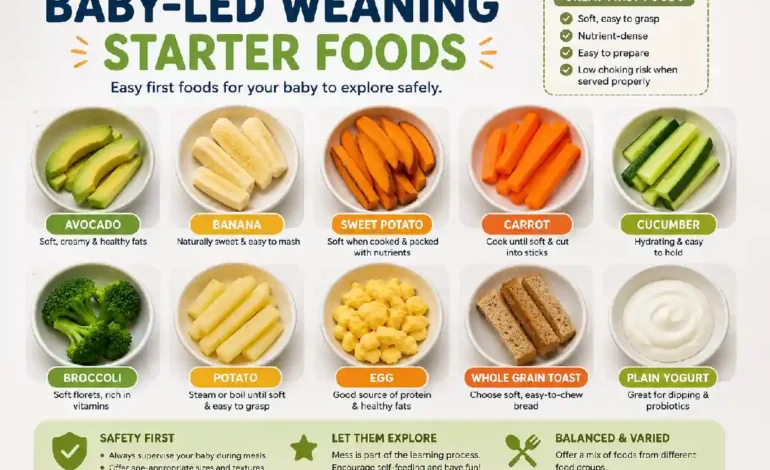
Introducing solids is a major step in your child’s life. If you have chosen to wean your baby through baby-led weaning, then it is an easy way to give your baby different kinds of tastes, textures, and shapes of food by yourself.
Unlike spoon-feeding baby purée foods, baby-led weaning includes feeding finger foods that can be picked up by babies. Some families practice baby-led weaning only, whereas some families combine baby-led weaning with spoon-feeding. There is no perfect method for feeding your baby as long as it ensures proper feeding of safe foods.
What Is Baby-Led Weaning?
Baby-led weaning refers to the practice where babies are trained to feed themselves with appropriate foods.
Some of the activities that may be carried out in baby-led weaning include:
- Feeding themselves by handling the foods.
- Taking the foods into the mouth
- Being introduced to different textures of foods
- Masticating and swallowing the food
- Gaining hand and eye coordination skills
- Controlling their feeding process depending on their satiety
When Can You Start Baby-Led Weaning?
Most babies will be able to begin taking complementary foods from when they are 6 months old. But age doesn’t make up the only criteria here.
The CDC states that some of the signs of readiness in babies are being able to sit independently or with help, having good head control, bringing things to the mouth, interest in food, and pushing food to the back of the mouth for swallowing.
It is not recommended to give solid food to a baby younger than 4 months old. If you have any doubts concerning the readiness of your baby for solid food due to premature birth or any other reason, contact your pediatrician or any other health professional.
Best Foods For Baby-Led Weaning
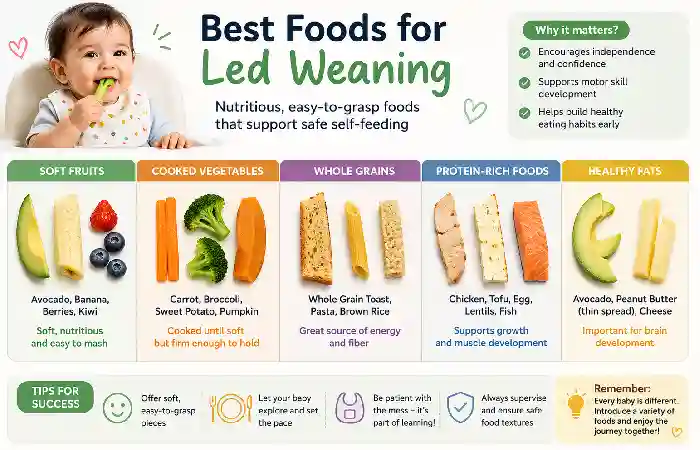
Some of the best foods are those that are soft and can be easily mashed, as well as come in the sizes and shapes that allow your baby to grab them.
There is no need to follow any strict order of food introduction to your baby. Any fruits, vegetables, protein, grains, dairy, and fats can consider.
1. Soft-Cooked Vegetables
The list of foods for your baby that are suitable for introducing new tastes and textures is wide.
It includes the following vegetables:
- Cooked broccoli florets
- Cooked sweet potatoes
- Cooked carrots
- Zucchini
- Cauliflower
- Butternut squash
- Green beans
- Cooked peas
- Avocado.
2. Soft Fruits
Fresh fruits are convenient for your baby to handle and experiment with.
You can try the following fruits:
- Bananas
- Avocados
- Fresh soft pears
- Fresh ripe peaches
- Melons
- Mangoes
- Cooked apples
- Cooked pears
Hard fruits are cooked to be made soft if necessary. Small fruits, such as grapes and cherry tomatoes, should be cut into small pieces.
3. Eggs
Eggs can be introduced to your baby from about 6 months and can be used in different meals.
They contain protein and other vitamins.
In case you choose baby-led weaning, you can introduce eggs to your baby in different forms that are easy to pick up, such as strips of omelet and cooked egg pieces.
4. Soft Meat and Fish
As soon as your baby begins to consume solids, meat and fish can become great sources of protein and various nutrients.
Examples of meat and fish are:
- Soft strips of chicken
- Shredded tender meat
- Soft fish
- Flaked fish without bones
- Tender turkey
According to CDC recommendations, it is necessary to remove all bones, skin, and extra fat from meats and fish, as well as to prepare them in a developmentally appropriate way.
5. Beans and Lentils
Consuming beans and lentils can prove useful because of their nutritional value.
Because whole beans can become a choking risk, they should be properly prepared, such as mashed, flattened, or mixed with other foods.
6. Full-Fat Yogurt and Cheese
You can introduce yogurt and properly pasteurized cheese at 6 months.
Yogurt can be given using a pre-loaded spoon or mixed with other soft foods. Cheese should be grated or thinly sliced, depending on your baby’s development.
It is advisable to select non-sweetened products and not to give salty foods often.
7. Soft Toast and Other Grains
Whole grains may also feature in a baby’s diverse diet.
Some examples may include:
- Crisps of toast
- Oatmeal
- Crisps of pasta
- Rice
- Crisps of chapatti
- Other properly cooked grains
To reduce the risk of forming a difficult-to-swallow lump, bread should be prepared in this way. According to the NHS, it is important to cut bread and similar products into strips.
Baby-Led Weaning Starter Foods Chart
| Food Group | Starter Food Examples | Preparation Idea |
| Vegetables | Broccoli, sweet potato, carrot, zucchini | Steam or cook until soft |
| Fruits | Banana, avocado, pear, melon | Serve soft; cook firm fruits |
| Protein | Egg, chicken, fish, tofu | Cook thoroughly and prepare softly |
| Legumes | Lentils, beans, chickpeas | Mash or soften |
| Dairy | Plain yogurt, pasteurized cheese | Use unsweetened options |
| Grains | Oatmeal, toast, pasta, rice | Cook until soft and prepare appropriately |
Choking Safety and Baby-Led Weaning
The preparation of foods may largely influence the risk of choking. The CDC states that foods should not be hard, sticky, small, or difficult to chew and swallow for little kids. Additionally, babies should eat sitting up straight and be supervised.
Foods to avoid due to the choking hazard include:
- Hard round whole nuts
- Grapes
- Hard uncut cherry tomatoes
- Hard raw carrots
- Hard raw apples
- Popcorn
- Large chunks of meat
- Sausages or hot dogs that are prepared incorrectly
- Hard whole beans
- Large chunks of cheese
- Spoons of thick nut butter
Introducing Common Allergens
Allergenic foods are not necessarily considered to avoid as allergens.
The CDC states that potential allergenic foods can introduce in the same way as complementary foods, such as egg, wheat, shellfish, and nut butters.
New foods should introduce properly, and you should pay attention to possible allergic reactions in your child.
If there are any concerns concerning allergies, for example, eczema and food allergy, it recommend to consult your baby’s pediatrician about introducing some potential allergens.
A baby should not be given a whole spoon of peanut butter since it increases the choking risk. The nut butter must dilute in order to be given or apply to other foods. It is dangerous to give whole nuts to babies.
Foods That Should Avoid/Limit
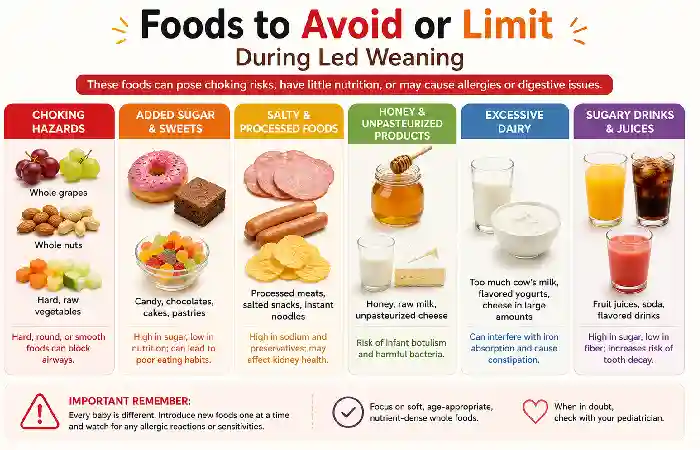
There are foods that can never introduce to the baby owing to choking dangers and food safety problems.
Do Not Introduce Whole Nuts
Whole nuts are associate with choking risks and should introduce no earlier than the age of five years. Nut products can safely consume from the very beginning of complementary feeding.
Avoid Honey Before 12 Months
Infants younger than 12 months must not take honey since there is a danger of developing infant botulism.
Limit Salt and Sugars
Baby food must not contain any salt or sugar since infants don’t require them. Parents shouldn’t use salty products and added sugars in making baby food according to NHS guidelines.
Certain Types of Fish that Contain Mercury Must Avoid
Baby-Led Weaning Diet: Shark, swordfish, and marlin contain large amounts of mercury and thus should exclude from a BLW diet.
Avoiding Raw Shellfish
Raw and partially cooked shellfish might pose a threat to babies’ health, as they can cause food poisoning.
What about Introducing Milk in the Baby-Led Weaning Stage?
Although babies start eating solid foods, breast milk or formula continues to vital for their healthy development in the first year.
The use of cow’s milk in cooking and mixing foods can done starting from the age of 6 months, and only after turning 12 months will the child use it as the main milk.
Water can offer together with meals starting from 6 months.
Simple Meal Ideas for Babies during BLW
Having introduced a number of foods, it’s time to combine them.
| Meal | Example |
| Breakfast | Soft banana + plain yogurt + oatmeal |
| Lunch | Soft broccoli + sweet potato + shredded chicken |
| Snack | Ripe avocado + toast strip |
| Dinner | Soft pasta + vegetables + flaked boneless fish |
| Vegetarian meal | Lentils + sweet potato + soft-cooked vegetables |
Tips for Successful Baby-Led Weaning
Even mess is a part of the process. Here are some tips that can help you through the process of introducing solid foods to your baby:
Dine together: Your baby can learn everything by imitating others.
Provide adequate portions: Start with a small amount of food and increase it when necessary.
Allow your baby to play with their food: Playing with food is a natural way to approach food.
Do not force your baby to eat anything: The appetite can differ every day.
Be diverse in food choices: Change vegetables, fruits, cereals, proteins, and any other foods appropriate for babies.
Make mealtime a quiet period: Never leave your baby alone during mealtime.
It is not about having perfect meals: It is about introducing different foods to your baby.
Final Thoughts
The selection of the appropriate food for baby-led weaning is not always complicate. It just takes ensuring that the process starts at the right developmental stage of your baby, exposing your baby to a variety of nutritious foods, and paying attention to how the food is prepare.
Foods such as soft vegetables, soft fruits, eggs, meats, beans, yogurts, and grains will help your baby get expose to a wide variety of flavors and textures. However, it is just as important that your baby is able to sit up, that there is supervision during mealtimes, and that age-appropriate foods are provided to your baby.
Children have their own pace of development; hence, some children will develop faster while others will develop slower. Should you have concerns regarding development, allergies, nutrition, and other issues associated with your baby, see your pediatrician.