Baby Girl Growth Chart (12–24 Months) – Ideal Height & Weight
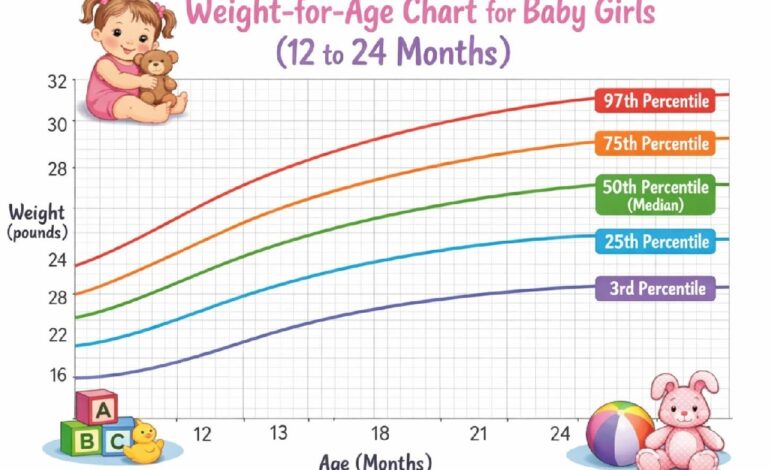
A baby girl weight chart for 12 to 24 months is a growth chart used to track the average and healthy weight ranges for girls aged 12 to 24 months. These charts help parents and healthcare professionals monitor a child’s growth and development over time.
The chart is typically based on growth rates compiled by organizations such as the World Health Organization and the Centers for Disease Control and Prevention. It demonstrates how a baby’s weight compares with other children of the same age by means of centiles or regular values.
Baby Girl Weight Chart (12–24 Months)
| Age (Months) | Average Weight (kg) | Average Weight (lbs) |
| 12 months | 8.9 kg | 19.6 lbs |
| 13 months | 9.2 kg | 20.3 lbs |
| 14 months | 9.4 kg | 20.7 lbs |
| 15 months | 9.6 kg | 21.2 lbs |
| 16 months | 9.8 kg | 21.6 lbs |
| 17 months | 10.0 kg | 22.0 lbs |
| 18 months | 10.2 kg | 22.5 lbs |
| 19 months | 10.4 kg | 22.9 lbs |
| 20 months | 10.6 kg | 23.4 lbs |
| 21 months | 10.9 kg | 24.0 lbs |
| 22 months | 11.1 kg | 24.5 lbs |
| 23 months | 11.3 kg | 24.9 lbs |
| 24 months | 11.5 kg | 25.4 lbs |
Baby Girl Growth Chart
1 to 12 Months
This chart helps track a baby girl’s weight and height during the first year of life. It’s based on WHO standards and shows average growth and healthy ranges.
Average Weight (kg) – 1 to 12 Months
| Age (Months) | Average Weight (kg) | Healthy Range (kg) |
| 1 | 4.3 | 3.6 – 5.0 |
| 2 | 5.1 | 4.3 – 5.8 |
| 3 | 5.8 | 4.9 – 6.4 |
| 4 | 6.4 | 5.5 – 7.0 |
| 5 | 6.9 | 6.0 – 7.5 |
| 6 | 7.3 | 6.4 – 8.0 |
| 7 | 7.6 | 6.7 – 8.3 |
| 8 | 7.9 | 7.0 – 8.6 |
| 9 | 8.2 | 7.3 – 8.9 |
| 10 | 8.5 | 7.5 – 9.2 |
| 11 | 8.7 | 7.7 – 9.4 |
| 12 | 8.9 | 7.9 – 9.6 |
Average Height (cm) – 1 to 12 Months
| Age (Months) | Average Height (cm) | Healthy Range (cm) |
| 1 | 54 | 51 – 57 |
| 2 | 57 | 54 – 60 |
| 3 | 60 | 57 – 63 |
| 4 | 62 | 59 – 65 |
| 5 | 64 | 61 – 67 |
| 6 | 66 | 63 – 69 |
| 7 | 67 | 64 – 70 |
| 8 | 68 | 65 – 72 |
| 9 | 70 | 67 – 73 |
| 10 | 71 | 68 – 74 |
| 11 | 72 | 69 – 75 |
| 12 | 73 | 70 – 76 |
13–24 Months
This chart tracks a baby girl’s weight and height from 13 to 24 months. Growth during this period is slower than the first year, but steady, reflecting increasing activity and diet variety.
Average Weight (kg) – 13 to 24 Months
| Age (Months) | Average Weight (kg) | Healthy Range (kg) |
| 13 | 9.2 | 8.2 – 9.9 |
| 14 | 9.4 | 8.4 – 10.1 |
| 15 | 9.6 | 8.6 – 10.3 |
| 16 | 9.8 | 8.8 – 10.5 |
| 17 | 10.0 | 9.0 – 10.7 |
| 18 | 10.2 | 9.2 – 10.9 |
| 19 | 10.4 | 9.4 – 11.1 |
| 20 | 10.6 | 9.6 – 11.3 |
| 21 | 10.8 | 9.8 – 11.5 |
| 22 | 11.0 | 10.0 – 11.7 |
| 23 | 11.2 | 10.2 – 11.9 |
| 24 | 11.5 | 10.4 – 12.2 |
Average Height (cm) – 13 to 24 Months
| Age (Months) | Average Height (cm) | Healthy Range (cm) |
| 13 | 74 | 71 – 77 |
| 14 | 75 | 72 – 78 |
| 15 | 76 | 73 – 79 |
| 16 | 77 | 74 – 80 |
| 17 | 78 | 75 – 81 |
| 18 | 79 | 76 – 82 |
| 19 | 80 | 77 – 83 |
| 20 | 81 | 78 – 84 |
| 21 | 82 | 79 – 85 |
| 22 | 83 | 80 – 86 |
| 23 | 84 | 81 – 87 |
| 24 | 85 | 82 – 88 |
25 to 36 Months
This chart shows the average weight and height for baby girls aged 25–36 months. Growth slows compared to infancy, but toddlers continue to develop steadily in weight, height, and motor skills.
Average Weight (kg) – 25 to 36 Months
| Age (Months) | Average Weight (kg) | Healthy Range (kg) |
| 25 | 11.7 | 10.6 – 12.4 |
| 26 | 11.9 | 10.8 – 12.6 |
| 27 | 12.1 | 11.0 – 12.8 |
| 28 | 12.3 | 11.2 – 13.0 |
| 29 | 12.5 | 11.4 – 13.2 |
| 30 | 12.7 | 11.6 – 13.4 |
| 31 | 12.9 | 11.8 – 13.6 |
| 32 | 13.0 | 12.0 – 13.8 |
| 33 | 13.2 | 12.2 – 14.0 |
| 34 | 13.4 | 12.4 – 14.2 |
| 35 | 13.6 | 12.6 – 14.4 |
| 36 | 13.8 | 12.8 – 14.6 |
Average Height (cm) – 25 to 36 Months
| Age (Months) | Average Height (cm) | Healthy Range (cm) |
| 25 | 85.5 | 82.5 – 88.5 |
| 26 | 86 | 83 – 89 |
| 27 | 86.5 | 83.5 – 89.5 |
| 28 | 87 | 84 – 90 |
| 29 | 87.5 | 84.5 – 90.5 |
| 30 | 88 | 85 – 91 |
| 31 | 88.5 | 85.5 – 91.5 |
| 32 | 89 | 86 – 92 |
| 33 | 89.5 | 86.5 – 92.5 |
| 34 | 90 | 87 – 93 |
| 35 | 90.5 | 87.5 – 93.5 |
| 36 | 91 | 88 – 94 |
What is a Good Weight for a Baby Girl?
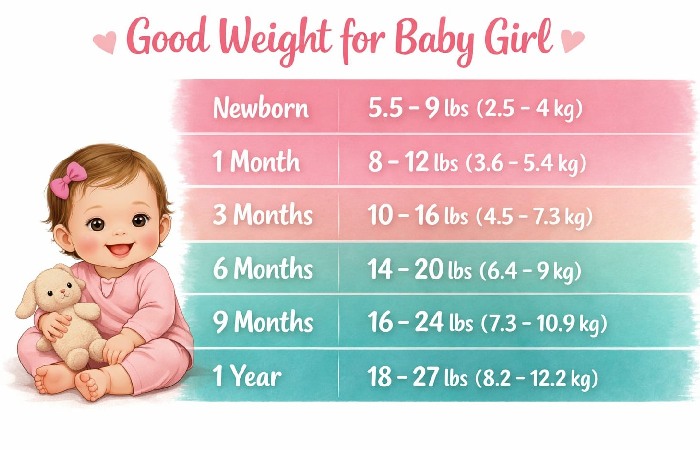
A good or healthy weight for a baby girl is contingent on her age, growth pattern, and overall health rather than a single number. Growth charts from the World Health Organization or the Centers for Disease Control and Prevention provide reference ranges for healthy weight at different ages.
Here’s some general advice:
Newborn (0–1 month): 2.5–4.0 kg (5.5–8.8 lbs)
6 months: 6.5–8.0 kg (14–17.6 lbs)
12 months: 8.5–9.5 kg (18.7–20.9 lbs)
24 months (2 years): 10.5–12.5 kg (23–27.5 lbs)
How Much Weight Do Babies Gain Between 12 and 24 Months?
Between 12 and 24 months, babies continue to grow progressively, but the pace of weight gain slows, as it did during On average, toddlers gain around 1.5 to 2.5 kilograms (3 to 5 pounds) over these 12 months. Growth can vary depending on genetics, nutrition, activity level, and overall health, but tracking weight with a growth chart helps ensure that your child is growing normally. A proper diet, lively play, and regular pediatric checkups promote healthy weight gain during this phase.
Key Points
Average Weight Gain: Approximately 1.5–2.5 kg (3–5 lbs) between 12 and 24 months.
Monthly Gain: Roughly 0.1–0.2 kg (0.2–0.4 lbs) per month.
Growth Patterns Vary: Some toddlers may gain more or less, depending on breakdown and activity levels.
Monitoring Helps: Growth charts ensure your toddler is on a healthy growth trajectory.
Supportive Factors: A stable diet, active play, and adequate sleep endorse steady weight gain.
What Should a 24-Month-Old Girl’s Weight Be?
A 24-month-old (2-year-old) girl typically weighs around 11.5 kg (25.4 lbs). Though healthy weights can vary, they are influenced by factors such as genetics, nutrition, activity level, and overall health.
Normally, the range for a 24-month-old girl is 10.5 kg (23 lbs) to 12.5 kg (27.5 lbs).
Paediatricians often use growth charts and World Health Organization percentiles to determine whether a child’s weight is within a healthy range.
Growth and Weight Guide for Baby Girl Weight Chart 12 to 24 Months
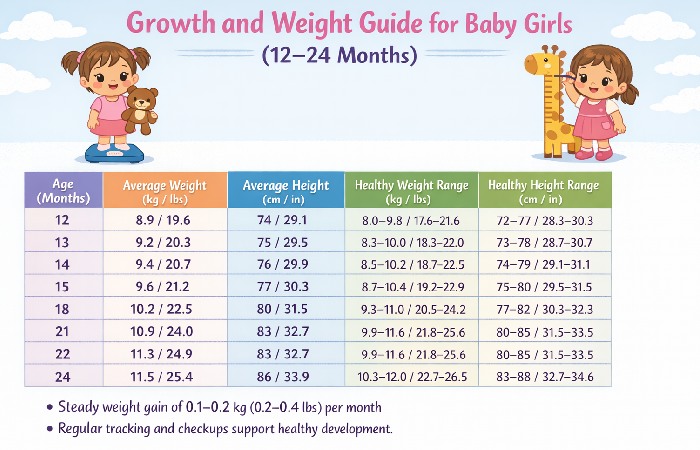
The 12 to 24 months period is a critical stage in a baby girl’s development, during which growth continues but at a slower pace than in the first year. Trailing weight and height over this period help parents and pediatricians monitor overall health, nutrition, and growth. Using standardized growth diagrams from the World Health Organization allows caregivers to compare a child’s growth with normal values and healthy growth curves for each month.
Nursing growth ensures that any nutritional deficiencies, growth delays, or health issues are identified early. Maintaining a balanced diet, encouraging active play, and ensuring adequate sleep support healthy growth, while regular pediatric checkups help track developmental milestones and weight progression.
Growth and Weight Guide for Baby Girl Weight Chart 12 to 24 Months
| Age (Months) | Average Weight (kg) | Average Weight (lbs) | Average Height (cm) | Average Height (inches) | Healthy Weight Range (kg) | Healthy Weight Range (lbs) |
| 12 | 8.9 | 19.6 | 74 | 29.1 | 8.0 – 9.8 | 17.6 – 21.6 |
| 13 | 9.2 | 20.3 | 75 | 29.5 | 8.3 – 10.0 | 18.3 – 22.0 |
| 14 | 9.4 | 20.7 | 76 | 29.9 | 8.5 – 10.2 | 18.7 – 22.5 |
| 15 | 9.6 | 21.2 | 77 | 30.3 | 8.7 – 10.4 | 19.2 – 22.9 |
| 16 | 9.8 | 21.6 | 78 | 30.7 | 8.9 – 10.6 | 19.6 – 23.4 |
| 17 | 10.0 | 22.0 | 79 | 31.1 | 9.1 – 10.8 | 20.0 – 23.8 |
| 18 | 10.2 | 22.5 | 80 | 31.5 | 9.3 – 11.0 | 20.5 – 24.2 |
| 19 | 10.4 | 22.9 | 81 | 31.9 | 9.5 – 11.2 | 21.0 – 24.7 |
| 20 | 10.6 | 23.4 | 82 | 32.3 | 9.7 – 11.4 | 21.4 – 25.1 |
| 21 | 10.9 | 24.0 | 83 | 32.7 | 9.9 – 11.6 | 21.8 – 25.6 |
| 22 | 11.1 | 24.5 | 84 | 33.1 | 10.1 – 11.8 | 22.3 – 26.0 |
| 23 | 11.3 | 24.9 | 85 | 33.5 | 10.3 – 12.0 | 22.7 – 26.5 |
| 24 | 11.5 | 25.4 | 86 | 33.9 | 10.5 – 12.2 | 23.1 – 26.9 |
When to Consult a Doctor?
It is important to consult a doctor if you notice any unusual changes in your baby girl’s growth or general health. Sudden slowing of weight gain, weight loss, or poor height growth can indicate fundamental health issues that need care. Persistent eating difficulties, vomiting, diarrhea, or lack of hunger are also cautionary signs.
Additionally, if your child falls far below or above normal growth percentiles on a growth chart, or if there are postponements in developmental milestones such as walking or speech, it’s vital to seek medical information. Early discussion allows for timely intervention, proper diagnosis, and guidance on nutrition and care to safeguard your baby’s healthy development.
Baby Growth Comparison
| Aspect | 1–12 Months | 12–24 Months |
| Growth Speed | Very rapid growth during the first year of life. | Growth slows down compared to the first year. |
| Average Weight Gain | Babies usually triple their birth weight by 12 months. | Weight increases gradually by about 2–3 kg during the second year. |
| Feeding Pattern | Mostly breast milk or formula with the introduction of solid foods around 6 months. | Toddlers eat family foods along with milk and a wider variety of nutrients. |
| Physical Development | Babies learn to roll, sit, crawl, and may start walking. | Toddlers walk, run, climb, and become more active. |
| Sleep Pattern | Sleep longer hours with multiple naps during the day. | Sleep becomes more structured with 1–2 naps per day. |
| Appetite | Appetite is usually strong due to rapid growth. | Appetite may fluctuate as activity increases. |
| Brain Development | Rapid brain growth and sensory development. | Language skills, memory, and learning abilities improve significantly. |
| Growth Monitoring | Growth tracked using charts recommended by organizations like the World Health Organization. | Growth continues to be monitored but changes occur more gradually. |
Growth and Development Differences
| Aspect | Baby Girls | Baby Boys |
| Birth Weight | Usually slightly lower than boys on average. | Usually slightly higher at birth. |
| Weight Gain | Girls may gain weight slightly slower than boys in the first year. | Boys often gain weight a bit faster, especially in the first 6–12 months. |
| Height Growth | Slightly shorter on average than boys at the same age. | Tend to be slightly taller than girls at the same age. |
| Growth Patterns | Steadier weight and height increase; may reach developmental milestones slightly earlier in some cases. | May have more rapid weight and height gains but sometimes slower coordination in early milestones. |
| Motor Skills | Often develop fine motor skills (like grasping, holding objects) a little earlier. | May excel in gross motor activities (like crawling, walking, running) slightly faster in some cases. |
| Activity Level | Can be slightly calmer and more focused during play at early stages. | Often more physically active and adventurous in the toddler stage. |
| Appetite | Appetite is generally steady but may vary with growth spurts. | Appetite may be stronger, especially during rapid growth phases. |
| Language Development | May begin speaking a few words slightly earlier than boys. | May start talking a little later but catch up by toddler age. |
| Puberty Onset (Later Stage) | Girls generally enter puberty earlier than boys. | Boys enter puberty later, typically 1–2 years after girls. |
Regular Tracking and Pediatric Checkups Ensure Steady and Safe Development
Yes! Regular tracking and pediatric checkups are essential for steady and safe development in toddlers. By monitoring weight, height, and other growth parameters at consistent intervals, parents and doctors can:
Identify growth trends: Ensure the child is gaining weight and height at a healthy pace.
Detect potential issues early: Spot underweight, overweight, or developmental delays before they become serious.
Adjust nutrition and care: Guide diet, feeding habits, and physical activity tailored to the child’s needs.
Ensure timely vaccinations and milestones: Track overall health, including motor skills, speech, and cognitive development.
Baby Girl Growth Chart vs Baby Boy Growth Chart (0–36 Months)
Growth charts help parents track their child’s weight, height, and overall development. Boys and girls grow at slightly different rates, especially in the first two years.
Average Weight (kg) – 0 to 36 Months
| Age (Months) | Baby Girls | Baby Boys |
| 0 (Birth) | 3.2 | 3.4 |
| 1 | 4.3 | 4.6 |
| 2 | 5.1 | 5.4 |
| 3 | 5.8 | 6.2 |
| 4 | 6.4 | 6.8 |
| 5 | 6.9 | 7.3 |
| 6 | 7.3 | 7.8 |
| 7 | 7.6 | 8.1 |
| 8 | 7.9 | 8.4 |
| 9 | 8.2 | 8.7 |
| 10 | 8.5 | 9.0 |
| 11 | 8.7 | 9.2 |
| 12 | 8.9 | 9.5 |
| 13 | 9.2 | 9.8 |
| 14 | 9.4 | 10.0 |
| 15 | 9.6 | 10.3 |
| 16 | 9.8 | 10.5 |
| 17 | 10.0 | 10.7 |
| 18 | 10.2 | 10.9 |
| 19 | 10.4 | 11.1 |
| 20 | 10.6 | 11.3 |
| 21 | 10.8 | 11.5 |
| 22 | 11.0 | 11.7 |
| 23 | 11.2 | 11.9 |
| 24 | 11.5 | 12.2 |
| 25 | 11.7 | 12.4 |
| 26 | 11.9 | 12.6 |
| 27 | 12.1 | 12.8 |
| 28 | 12.3 | 13.0 |
| 29 | 12.5 | 13.2 |
| 30 | 12.7 | 13.4 |
| 31 | 12.9 | 13.6 |
| 32 | 13.0 | 13.8 |
| 33 | 13.2 | 14.0 |
| 34 | 13.4 | 14.2 |
| 35 | 13.6 | 14.4 |
| 36 | 13.8 | 14.6 |
Average Height (cm) – 0 to 36 Months
| Age (Months) | Baby Girls | Baby Boys |
| 0 (Birth) | 49 | 50 |
| 1 | 54 | 55 |
| 2 | 57 | 58 |
| 3 | 60 | 61 |
| 4 | 62 | 63 |
| 5 | 64 | 65 |
| 6 | 66 | 67 |
| 7 | 67 | 68 |
| 8 | 68 | 69 |
| 9 | 70 | 71 |
| 10 | 71 | 72 |
| 11 | 72 | 73 |
| 12 | 73 | 74 |
| 13 | 74 | 75 |
| 14 | 75 | 76 |
| 15 | 76 | 77 |
| 16 | 77 | 78 |
| 17 | 78 | 79 |
| 18 | 79 | 80 |
| 19 | 80 | 81 |
| 20 | 81 | 82 |
| 21 | 82 | 83 |
| 22 | 83 | 84 |
| 23 | 84 | 85 |
| 24 | 85 | 86 |
| 25 | 85.5 | 86.5 |
| 26 | 86 | 87 |
| 27 | 86.5 | 87.5 |
| 28 | 87 | 88 |
| 29 | 87.5 | 88.5 |
| 30 | 88 | 89 |
| 31 | 88.5 | 89.5 |
| 32 | 89 | 90 |
| 33 | 89.5 | 90.5 |
| 34 | 90 | 91 |
| 35 | 90.5 | 91.5 |
| 36 | 91 | 92 |
Conclusion
Monitoring a baby girl weight chart 12 to 24 months is vital for ensuring her healthy physical and developmental development. Using growth charts for weight, height, and head circumference helps parents and pediatricians identify normal growth patterns and detect possible concerns.
A balanced diet, regular physical activity, routine health checkups, proper sleep, and an inspiring setting are key factors in supporting healthy growth. By staying focused on her development and consulting a doctor when necessary, parents can help their toddler achieve optimal health, strength, and overall well-being during this critical stage of life.
FAQs
What is the regular Baby Girl Weight Chart 12 to 24 Months?
About 8.9 kg (19.6 lbs).
How much does a baby girl grow in height from 12 to 24 months?
About 12 cm, from ~74 cm to ~86 cm.
Why are growth charts important?
They help support healthy pathway development and identify potential growth areas.
When would I consult a doctor about my baby’s growth?
If weight or height growth is strangely slow, drops, or falls below percentiles, it is dangerous.
How can I promote healthy growth in my toddler?
Provide balanced nutrition, encourage play, support sleep, and schedule regular examinations.
Do all babies grow at the same rate?
No, growth rates vary due to heredity, nutrition, and overall well-being.
Can growth charts predict my baby’s adult height?
They give an estimate, but genetics and the situation also play major roles.
How often must I track my baby’s growth?
Monthly tracking is suggested during the second year.
Is weight gain gentler after 12 months normal?
Yes, growth obviously slows in the first year.
Are there tools to track development at home?
Yes, home charts, apps, and pediatrician-provided trailers can help.