How Much Caffeine Is in a 12 oz Cup of Coffee?
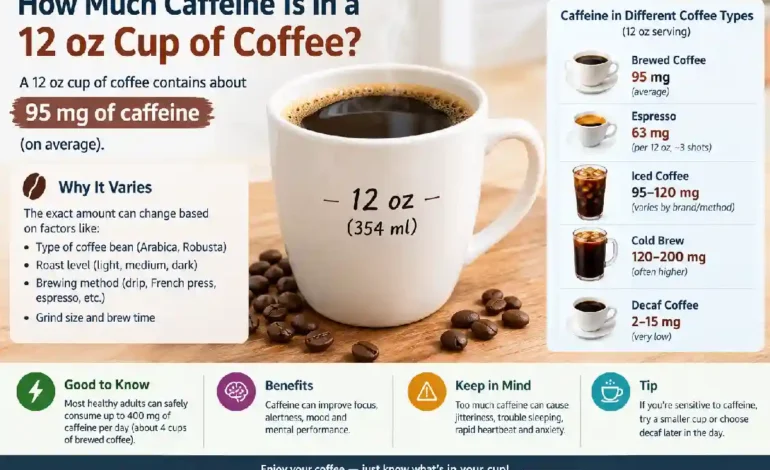
Hence, if you drink coffee as the energy source for the day, you might be interested in knowing the amount of caffeine in a 12 oz cup of coffee. There’s no single answer because caffeine content varies in different coffee beans.
Based on the data obtained from the Food and Drug Administration (FDA), a 12-fluid-ounce serving of regular brewed coffee that does not belong to the specialty coffee category contains 113 to 247 milligrams (mg) of caffeine.
It is a big range. It means that 2 cups of coffee (12 oz each) will vary greatly in terms of caffeine content, even though they are all labeled as “coffee”.
How Much Caffeine Is in a 12 Oz Cup of Coffee?
The 12 oz cup of coffee contains 113- 247 mg of caffeine, according to the FDA.
For a quick reference:
| Coffee or beverage | Approximate caffeine |
| 12 oz regular brewed coffee | 113–247 mg |
| 8 oz coffee | About 80–100 mg in some typical estimates |
| 12 oz green tea | About 37 mg |
| 12 oz black tea | About 71 mg |
| 12 oz caffeinated soft drink | About 23–83 mg |
| 12 oz energy drink | About 41–246 mg |
| 8 oz decaf coffee | About 2–15 mg |
It could turn out to be quite another case altogether depending upon the product and its preparation method.
Why Does 12 Oz of Coffee Contain Different Amounts of Caffeine?
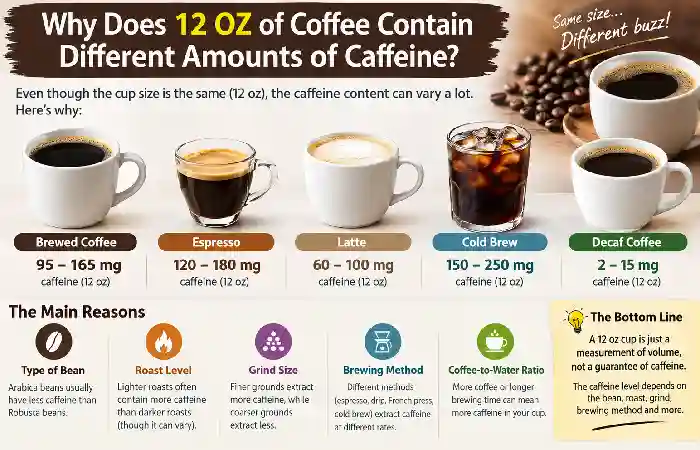
There are a number of factors that determine the caffeine content in coffee.
1. The Type of Coffee Beans Used
Most of the time, two types of coffee beans are used for making coffee: Arabica and Robusta.
The latter type of beans contains a higher caffeine content than the former. That is why coffee made from Robusta beans would contain more caffeine than Arabica coffee.
But it is not the only factor responsible for caffeine content in coffee; the caffeine content also depends upon roasting, grinding, and brewing methods used.
2. The Method of Brewing
It is a fact that the method of brewing influences the level of caffeine in the coffee.
For example, the levels of caffeine per ounce might differ between the following: brewed coffee, cold brew, espresso, and instant coffee.
The more extraction of coffee grounds during brewing, the more caffeine dissolves in the process.
3. Coffee-to-Water Ratio
Increasing the proportion of coffee grounds used in comparison to the water will result in higher concentrations of caffeine in the finished product.
Two individuals can brew an equal quantity of coffee, but use unequal amounts of grounds and have very distinct caffeine contents in their respective brews.
4. Serving Size
This factor is especially important.
The term “cup” can mean different volumes in various contexts. Informally, it can stand for a rather big mug, whereas nutrition tables and brands of coffee can specify a certain amount of fluid ounces.
A 12-ounce serving is 355 milliliters.
Drinking a 16-ounce or 20-ounce serving means consuming not only more liquid but possibly more caffeine compared to a 12-ounce serving.
5. Brand and Preparation
Coffee drinks from restaurants and coffee shops can vary significantly.
The FDA states that caffeine amounts for certain products and volumes may differ and suggests contacting the producer or seller when the amount is not provided.
Is 200 mg of Caffeine a Lot?
For adults, 200 mg of caffeine cannot be considered excessively large.
It meets the FDA-recommended daily dose, which does not exceed 400 mg for most adults.
However, the effect may differ from one individual to another.
One can safely drink 200 mg of coffee without having any problems, while others may encounter such side effects as:
- Sweating
- Anxiety
- Irritability
- Quickened heartbeat
- Sleep disorders
- Migraines
- Digestive disorders
If you experience such adverse effects after drinking coffee, then you have lower tolerance than another person.
How Much Caffeine Should Be Consumed Daily?
According to the FDA, 400 mg of caffeine intake per day would not pose any danger to adults.
According to the FDA, it is equal to 2-3 cups of 12-ounce coffee, even though the amount of caffeine varies.
It is just an approximate value, and not everyone should follow it.
For instance, if one takes 12 ounces of coffee containing 200 mg of caffeine, then 400 mg can be obtained in two cups.
When one cup of coffee contains 120 mg of caffeine, 3 cups of coffee provide 360 mg.
| Number of 12 oz cups | If each has 113 mg | If each has 247 mg |
| 1 cup | 113 mg | 247 mg |
| 2 cups | 226 mg | 494 mg |
| 3 cups | 339 mg | 741 mg |
| 4 cups | 452 mg | 988 mg |
How Does Coffee Compare to Other Caffeinated Drinks?
These are tea, soda, energy drinks, chocolate, some supplements, and medications.
The table below provides caffeine content ranges per one 12-fluid-ounce serving as recommended by the FDA:
| Beverage | Typical caffeine in 12 oz |
| Regular brewed coffee | 113–247 mg |
| Green tea | 37 mg |
| Black tea | 71 mg |
| Caffeinated soft drink | 23–83 mg |
| Energy drink | 41–246 mg |
How Long Does Caffeine Stay In Your System?
Caffeine is a drug that quickly enters the bloodstream.
Factors that affect sensitivity to caffeine include:
- Metabolic rate
- Genetic susceptibility
- Drugs
- Pregnancy
- Some illnesses
- Consumption quantity
- Caffeine consumption frequency
Signs You May Be Drinking Too Much Caffeine
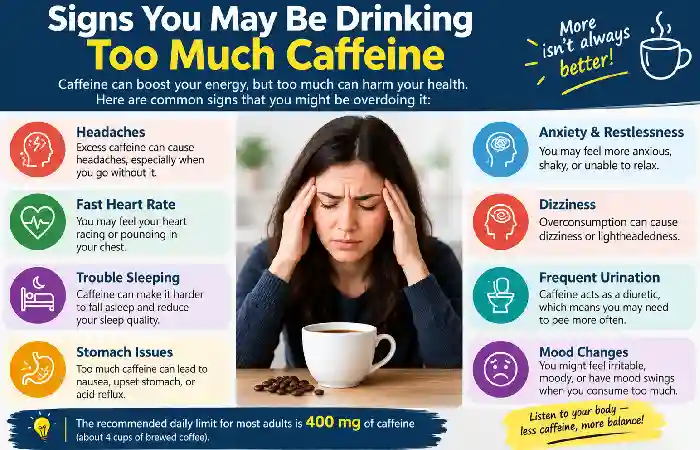
Taking in more caffeine than your body can tolerate will result in many signs.
The signs include:
- High heart rate
- Palpitations
- Anxiety
- Jitters
- Restlessness
- Migraines
- Insomnia
- Digestive issues
How to Reduce Your Caffeine Intake
If you happen to be a large consumer of caffeine and wish to decrease your consumption of it, doing it gradually may work better than quitting abruptly.
As mentioned by the FDA, although caffeine withdrawal does not necessarily mean danger, the experience is not a pleasant one and is best managed through gradual consumption reduction.
Try these approaches:
Reduce Your Cup Size
Opt for a smaller cup size if you tend to drink 16 or 20 ounces of coffee.
Regular and Decaf Blends
Gradual replacement of regular coffee with decaf may help reduce your caffeine consumption.
Coffee Intake Time
If you think that your caffeine consumption is affecting your sleep pattern, try changing your coffee intake time.
Sources of Caffeine Intake
Make sure to factor in all the sources of your caffeine consumption, such as tea, energy drinks, soft drinks, chocolate, supplements, and medication where applicable.
Final Takeaway
So, how much caffeine is contained in 12 ounces of coffee? According to the FDA, the content of caffeine in a 12-ounce serving of regular brewed coffee is 113-247 mg.
According to the FDA, it is considered to be safe for an average healthy person to consume up to 400 mg of caffeine daily. Nevertheless, it is only general advice that may not be appropriate for all people because of different caffeine tolerances.
If you drink several cups of coffee per day, the caffeine amount contained in each of them will give you a better idea about your daily caffeine dose than the number of coffee servings.
Disclaimer: Information provided above is general and cannot be taken as personal medical advice. In case you have some health problems or use any medications, it is highly advised to consult a physician before using the substance mentioned above.